

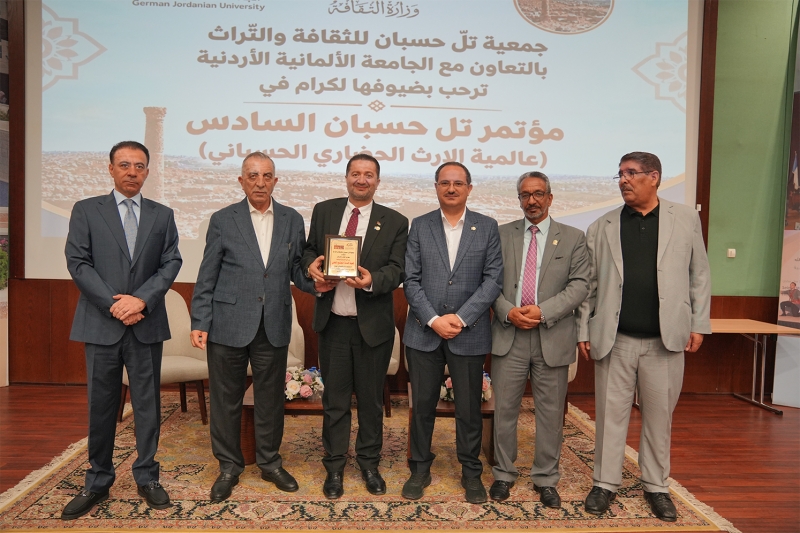
 Minister of Culture Mustafa Al-Rawashdeh patronized the “Tal Hesban for Culture and Heritage: A Civilizational Legacy toward Future Horizons” Conference on Tuesday. The conference was organized by the Tal Hesban Association for Culture and Arts in cooperation with the German Jordanian University (GJU), and was attended by GJU President Prof. Ala’aldeen Al-Halhouli, Governor of Naour District Shadi Al-Bakhit, as well as a number of senators, academics, community leaders, and residents of the area.
In his remarks, Al-Rawashdeh stressed the importance of documenting Jordanian history and heritage and raising awareness of the Kingdom’s rich civilizational and human dimensions, noting that Jordan’s history spanning different eras constitutes an essential part of national identity and collective memory.
He commended the organization of the conference, which highlights the relationship between the past and present while looking toward the future, emphasizing its alignment with the Ministry of Culture’s efforts to implement the “Jordanian Narrative” program, which aims to document Jordan’s history and highlight its civilizational and human heritage.
He noted that the Ministry has organized a number of dialogue sessions across the governorates on the “Jordanian Narrative,” bringing together academics, researchers, and experts from various humanities disciplines. It has also launched the “Stories from Jordan” platform, which seeks to document the Kingdom’s history across its different historical periods, stressing that the land of Jordan has been continuously inhabited since ancient times.
Al-Rawashdeh highlighted the significance of Hesban District, known in ancient times as “Heshbon,” as a testament to the depth of Jordan’s history. He explained that the area witnessed settlement across different periods and had a presence during the Byzantine era, while it was known as “Hesban” during the Islamic periods and served during the Mamluk era as an administrative center.
He said that Tal Hesban represents a layered historical record, with successive civilizations dating from the Iron Age through the Hellenistic, Roman, Byzantine, and Islamic periods, and extending to the Mamluk era and the modern Jordanian state. He emphasized that documenting history and heritage contributes to preserving national memory, strengthening identity, and raising awareness among generations through various forms of cultural and artistic expression that highlight the story of the land and its people.
During the conference, Al-Rawashdeh announced the establishment of a Folk Life Museum and a library in Naour District, as well as efforts to establish an annual cultural festival in cooperation with the relevant national entities and institutions in the district.
The conference was organized as part of the cooperation between the Tal Hesban Association for Culture and Arts and GJU, with the aim of introducing the area’s civilizational and cultural heritage, promoting research and dialogue on its history and heritage components, and highlighting its rich historical and civilizational landmarks.