

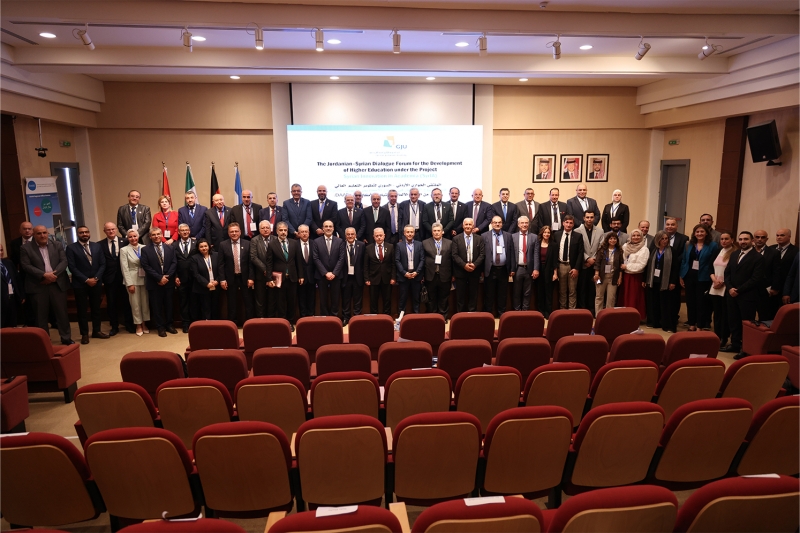
 Amman – The activities of the Jordanian–Syrian Higher Education Dialogue Forum were launched at the German Jordanian University (GJU), held on May 3–4, 2026, as part of the “Innovation in the Syrian Academic Sector” (SyrIA) project. The event brought together high-level ministerial and academic participation from Jordan and Syria, alongside international partners, in a strategic step aimed at supporting and modernizing the higher education system in the Syrian Arab Republic on sustainable foundations based on quality and innovation.
The forum is being held within the context of integrated regional and international efforts to enhance the readiness of Syria’s higher education sector during a transitional phase and to enable it to contribute effectively to development and reconstruction. This is pursued through advancing academic governance, building institutional capacities, and aligning educational outcomes with labor market needs. The project is implemented with support from the German Academic Exchange Service (DAAD) and funded by the German Federal Foreign Office.
The forum served as a strategic platform bringing together academic decision-makers, with discussions focused on shaping shared visions for developing higher education, expanding partnerships among universities, and strengthening applied scientific research in line with current challenges, while opening broader prospects for regional academic integration.
The Minister of Higher Education and Scientific Research in the Hashemite Kingdom of Jordan, Prof. Azmi Mahafzah, emphasized that the forum represents a pivotal milestone for transitioning from dialogue to implementation, toward building a sustainable strategic partnership between Jordan and Syria. He noted that universities constitute a fundamental pillar of development and a driver of knowledge production across sectors.
He explained that this meeting reflects a shared political and academic will to strengthen cooperation at a critical stage that requires integrated efforts and unified visions. He added that higher education is no longer limited to its traditional academic role, but has become an effective tool for achieving societal stability and economic growth, as well as a key driver of reconstruction based on modern foundations of innovation and knowledge.
Mahafzah pointed out that Jordan views this cooperation as a strategic opportunity to integrate resources and expertise, drawing on the scientific competencies and advanced infrastructure available in universities in both countries, alongside international support—particularly from the German Federal Foreign Office and the German Academic Exchange Service (DAAD)—which is a decisive factor in ensuring the success of these efforts.
He stressed the need to translate the outcomes of the forum into tangible practical steps by launching a package of initiatives. These include developing joint academic and research programs that respond to labor market needs, especially during the reconstruction phase, and launching a Forum of Jordanian and Syrian University Presidents as a permanent institutional platform for dialogue and strategic planning. This would be accompanied by strengthening academic governance, consolidating quality assurance and accreditation standards, and supporting applied scientific research linked to development challenges.
He also highlighted the importance of leveraging technology and digital education to expand access to learning and enhance flexibility, noting that the next phase will also require engaging regional and international partners, including funding institutions and development organizations, to ensure the sustainability of these initiatives and maximize their long-term impact.
For his part, the Minister of Higher Education and Scientific Research of the Syrian Arab Republic, Prof. Marwan Al-Halabi, outlined the future vision for developing Syrian universities, emphasizing the importance of academic openness and strengthening regional and international partnerships to improve the quality of education and scientific research. He also announced the launch of the Regional Academic Partnership Forum for Higher Education.
The President of GJU, Prof. Ala’aldeen Al-Halhouli, expressed pride in hosting this event, affirming that the project aligns with the university’s mission of applied education and partnerships with various sectors in accordance with the German model, which links knowledge with practice.
Al-Halhouli added that the Innovation in the Syrian Academic Sector project directly aligns with the university’s vision and mission, which since its establishment has been based on applied partnerships and linking education to real-world needs and labor market demands, inspired by the German applied education model, where real learning is achieved through practice and collaboration with various sectors.
He noted that the project builds on a long history of strong fraternal relations and solid ties between Jordan and Syria, formed over decades of scientific, cultural, and humanitarian cooperation, serving today as a foundation for deeper and more sustainable partnerships.
Al-Halhouli emphasized that the university sees this project as a genuine opportunity to strengthen integration between universities, industry, and international partners, transforming knowledge into tangible impact that contributes to capacity building, institutional development, and innovation as a driver of other development sectors.
He further stated that the project represents a practical platform for rethinking education models, enhancing applied learning, linking outcomes to labor market needs, and qualifying human resources and building capacities. This will contribute to a rapid qualitative transformation in Syria’s higher education system, keeping pace with technological advancement and strengthening international competitiveness.
The Deputy German Ambassador, Mr. Guido Kimmerling, reaffirmed his country’s commitment to supporting efforts to develop higher education in Syria, stressing the importance of international cooperation and academic exchange in strengthening the stability of the academic sector and enabling it to fulfill its developmental role.
The forum included a high-level panel discussion titled “Alliance for Syrian Higher Education”, which explored opportunities for building strategic academic alliances between Jordan, Syria, and Germany, in addition to a closed session for university presidents focusing on mechanisms for networking and building direct partnerships between educational institutions.
In the same context, the Vice President of GJU for International Affairs and Project Director, Prof. Ralf Roßkopf, presented the project’s components, which include strategic dialogues, workshops, training programs, academic and administrative mentoring activities, and scientific conferences, based on an evidence-based methodology in cooperation with the University of Hamburg to ensure academic quality.
The project is scheduled to continue until the end of 2027, opening opportunities for Syrian and German universities to further develop academic relations, launch joint projects, and access additional funding opportunities in the fields of exchange and international cooperation.
This forum represents an advanced step toward building an integrated regional model for cooperation in higher education, based on knowledge exchange and expertise sharing, supporting sustainable development and fostering impactful long-term partnerships.