

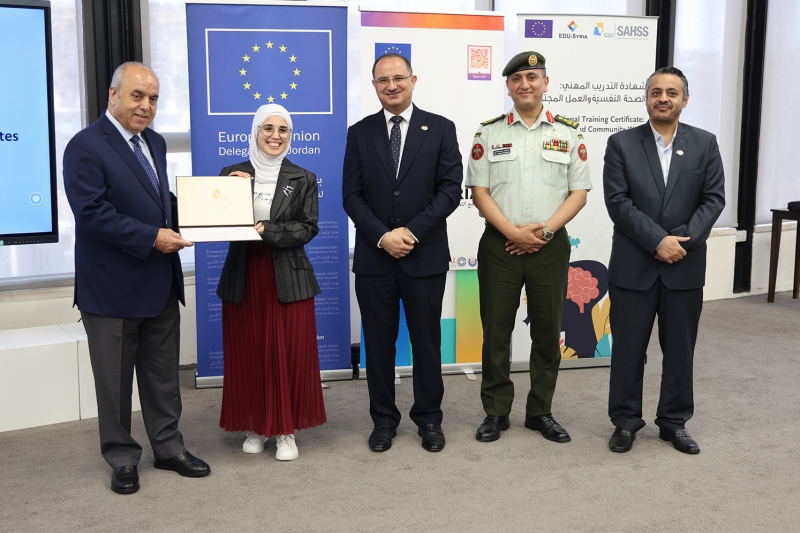
 On Saturday, Minister of Education and Human Resources Development Dr. Azmi Mahafzah, in the presence of President of the German Jordanian University (GJU) Prof. Ala’aldeen Al-Halhouli, patronized the graduation ceremony of the second cohort of the Training Diploma in Mental Health and Community Work. The diploma was organized by the Department of Social Work at the School of Applied Humanities and Social Sciences (SAHSS), in cooperation with the Consultation and Training Center, with the participation of 30 trainees from a number of national and community institutions.
The ceremony was attended by Director of the Directorate of Military Education and Culture at the Jordanian Armed Forces–Arab Army, Brigadier General Dr. Saleh Al-Khalayleh, and Head of the Community Policing Division at the Public Security Directorate, Lieutenant Colonel Hamza Al-Wreikat, along with a number of members of the Jordanian-Syrian Education Program team.
The cohort included 20 participants from the Ministry of Education, four from the Directorate of Military Education and Culture, three from the Media and Community Policing Department at the Public Security Directorate, in addition to three Syrian participants funded by the Jordanian-Syrian Education Program. This reflects the importance of integrating efforts and exchanging expertise in fields related to individuals and communities.
President Prof. Ala’aldeen Al-Halhouli affirmed that the University’s mission extends beyond education within classrooms to serving the community and to every field in which knowledge and expertise can make a tangible difference in people’s lives.
He noted that the program combined academic knowledge with practical application and was delivered over four months, totaling 180 training hours equivalent to 15 credit hours, under the supervision of specialized academic experts from the Department of Social Work. This contributed to developing participants’ capacities and enhancing their readiness to address mental health and community work issues with competence and humanity.
Al-Halhouli commended the partnership with the Ministry of Education, which resulted in the program being accredited for teachers’ promotion purposes, stressing that this reflects the alignment of the University’s programs with the needs of the educational and professional sectors and enhances their impact on developing the capacities of sector employees.
He emphasized that the true value of any training program is not measured by the number of hours or certificates it offers, but rather by the impact it creates in people’s lives and in the workplace. He called on the graduates to apply the knowledge and expertise they had acquired within their institutions and communities and transform them into sustainable impact.
For his part, Dean of SAHSS, Dr. Haitham Thawabih, affirmed that mental health and community work constitute essential pillars in addressing contemporary challenges and pressures, highlighting the importance of preparing qualified professionals equipped with the knowledge and skills necessary to support individuals and strengthen community cohesion.
He added that graduating this cohort does not mark the end of the program, but rather the beginning of a new professional and humanitarian responsibility, calling on the graduates to transfer what they had learned to their institutions and communities and turn knowledge into practice and tangible impact.
For his part, First Lieutenant Dr. Baraa Al-Saqour, representing the graduates, expressed the participants’ pride in the experience, affirming that the program contributed to developing their knowledge and skills, provided them with opportunities to exchange expertise, and enhanced their professional capacities in ways that serve their institutions and communities.
At the conclusion of the ceremony, certificates were distributed to the participating graduates.