

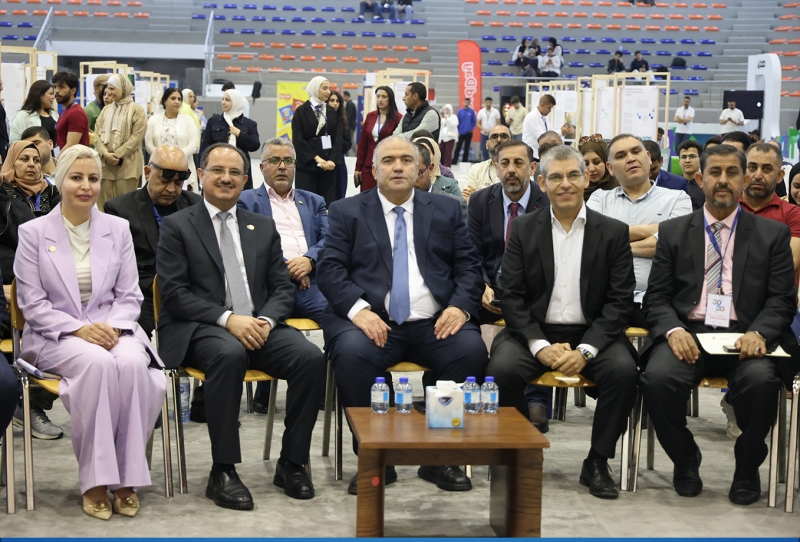
 Under the patronage of Prof. Mohammad Ghaith, Secretary-General of the Ministry of Education for Technical and Technological Affairs, representing Prof. Azmi Mahafzah, Minister of Education, the closing ceremony of the school track of the annual (GJU 3030) competition in its third edition was held. The competition was organized by the German Jordanian University (GJU) under the theme “Future Technology”, with broad participation from public and private schools, the Directorate of Education, and Military Culture Schools.
The competition served as an inspiring national platform to discover students’ talents and creativity. It targeted students from grades nine through twelve and aimed to develop their skills in technology and innovation, encouraging creative thinking and the development of practical solutions to future challenges.
Student projects were distributed across several key areas, including artificial intelligence and machine learning, robotics and drones, cybersecurity, sustainable and green technologies, and the Internet of Things (IoT), in addition to a special track titled “The Future of the Architect/Designer in the Age of Automation.” Other emerging technological ideas also reflected the diversity of students’ interests and their ability to integrate multiple disciplines.
Professor Dr. Mohammad Ghaith emphasized the importance of transitioning toward applied education that connects knowledge with the labor market, noting that this approach opens broader horizons for students to choose their academic and career paths based on their interests. He also highlighted the Ministry’s efforts to develop students’ skills from early stages, pointing out the existence of around 1,700 vocational education workshops in public schools. He further noted the growing demand for the (BTEC) program due to the real opportunities it provides in preparing qualified and competitive graduates.
For his part, Prof. Alaaldeen Al-Halhouli, President of GJU, explained that the competition reflects the University’s vision of building effective partnerships with the educational community and fostering an environment of innovation among school students. This contributes to preparing a capable generation equipped with future skills and able to keep pace with rapid technological changes.
In turn, Dr. Farah Al-Atrash, Dean of Student Affairs, affirmed that the competition aligns with the University’s commitment to empowering students, refining their skills, and promoting a culture of entrepreneurship and creativity. She added that it also provides an interactive environment where students can showcase their projects and exchange experiences, enhancing their confidence and motivating them to continue in innovation pathways.
The competition witnessed remarkable participation from school students, with 500 students applying and 100 projects qualifying for advanced stages—reflecting the growing interest in technological education and innovation across the Kingdom.
At the conclusion of the event, GJU expressed its appreciation for the support provided by Housing Bank, which contributed to the success of the competition and enhanced its impact. The University emphasized the importance of partnership with the banking sector in supporting educational and innovative initiatives and empowering youth to develop their ideas into promising future projects.