

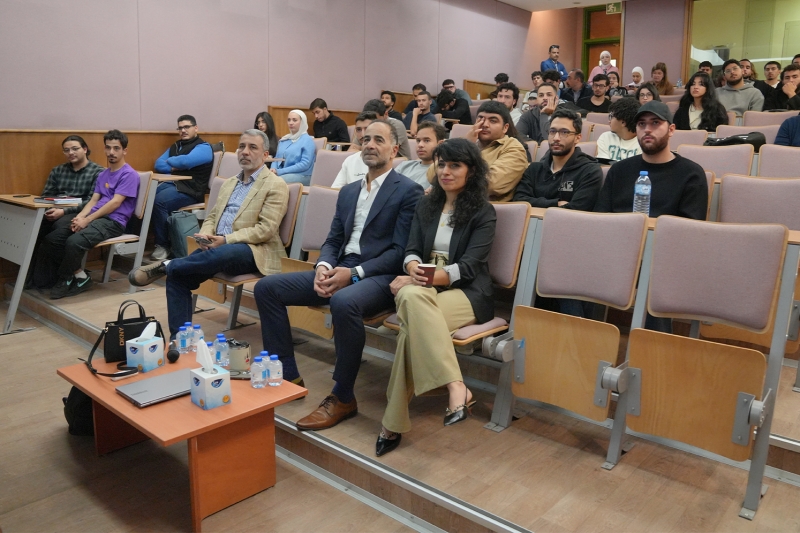
The School of Applied Technical Sciences (SATS) at the German Jordanian University (GJU) organized a specialized lecture titled “From Palm to Plate: Digital Twins in the Date Supply Chain,” delivered by Hala Abu Hantash, Chief Executive Officer of Palmera Dates.
The lecture was attended by Prof. Aiman Al-Share, Dean of SATS; Dr. Sahar Qaadan, Vice Dean of the Deanship of Innovation, Technology Transfer and Entrepreneurship (DI-TECH); and Prof. Safwan Al-Tarazi, a faculty member at SATS, alongside a number of academic and administrative staff members and university students.
During the lecture, Abu Hantash presented the company's experience in leveraging digital solutions to manage the date supply chain, from farms and harvesting operations to sorting, packaging, storage, distribution, and export. She highlighted the role of modern technologies in advancing the agricultural sector, improving production efficiency, and enhancing supply chain management.
The lecture explored the concept of Digital Twins and its applications in monitoring agricultural and production processes and analyzing data. It also addressed the role of Enterprise Resource Planning (ERP) systems in integrating and standardizing data and enhancing product traceability. In addition, it highlighted the use of the Internet of Things (IoT) to monitor environmental conditions, artificial intelligence in date sorting and grading, and historical data to forecast production, schedule harvesting, and manage inventory and distribution.
Abu Hantash also discussed the main challenges facing digital transformation in the agricultural sector, including limited internet connectivity in some agricultural areas, climate change, and storage and transportation challenges. She highlighted the importance of leveraging data and modern technologies to address these challenges and improve operational efficiency.
The session ended with an open discussion, giving attendees the opportunity to raise questions about the use of technology in agriculture. Topics included the reuse of packaging materials, the adaptability of automated systems to changing operational needs, and the effects of climate change on farming practices.