

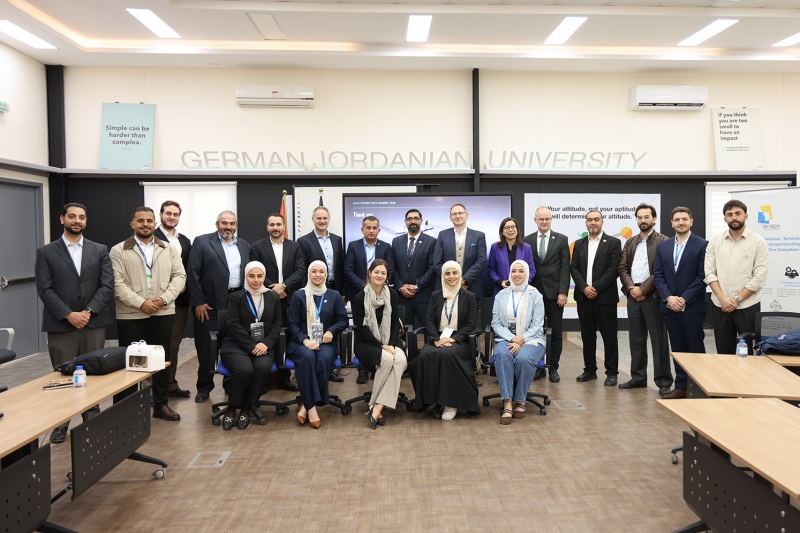
 As part of the Future Tech Summit 2026, the German Jordanian University (GJU) organized the Industrial Partnership Conference (IPC 2026) on Tuesday, October 20, bringing together representatives from industry, universities, and governmental and international institutions. The conference aimed to strengthen collaboration between academia and industry and develop practical partnerships in research and development, innovation, and technology transfer.
In his opening remarks, GJU President Prof. Ala’aldeen Al-Halhouli highlighted the university’s commitment to strengthening academia–industry collaboration and translating knowledge and innovation into practical applications and economic opportunities. He noted that these efforts support entrepreneurship, technology transfer, and the creation of high-quality employment opportunities for graduates.
He added that GJU seeks to move beyond traditional forms of cooperation with industry by developing joint applied research projects, establishing specialized laboratories, supporting startups, and exploring new opportunities in technology development and investment. He called on industry representatives, business partners, and investors to work with the university and share challenges and ideas that could be transformed into opportunities for innovation.
Prof. Al-Halhouli also highlighted GJU’s use of its academic expertise and network of partnerships with German universities and industrial institutions to connect Jordanian talent and innovation with international expertise, technologies, and markets. These efforts, he noted, contribute to Jordan’s economic modernization and strengthen the competitiveness of the national economy. He stressed the importance of turning discussions and agreements into concrete commitments and projects that deliver lasting benefits for the university, its partners, and the national economy.
For his part, Prof. Osama Saadeh, Dean of the Innovation, Technology Transfer and Entrepreneurship (DI-TECH), explained that GJU aims to build effective partnerships with industry that go beyond supplying the labor market with graduates. These partnerships also seek to prepare skilled professionals who can contribute to the sector’s development and lead change, drawing on the university’s role as a bridge between Jordan and Germany.
Prof. Saadeh added that the dean’s office works to commercialize research outputs, facilitate technology transfer, and strengthen industry collaboration as part of GJU’s innovation ecosystem, including the Technology, Research, and Innovation Park (TRIP). He encouraged participants to use the discussions and bilateral meetings to establish new partnerships among institutions, companies, researchers, and students in Jordan and Germany, and to turn opportunities for cooperation into tangible, sustainable projects.
The conference featured a panel discussion titled “From National Priorities to Industrial Impact: Partnerships and Innovation in Practice,” moderated by GJU alumnus Walid Alsaleh. The panel explored ways to translate national priorities and industrial needs into opportunities for collaboration. Participants included Salah Aljamaani from the Deutsche Gesellschaft für Internationale Zusammenarbeit GmbH (GIZ); Doaa Al-Khraisha from the Amman Chamber of Industry (ACI); Yaman Ryalat from BayWa; Dr. Uli Blessing from MAHLE; and Layan Al-Maani from Aramex.
The conference also witnessed the signing of several agreements and memoranda of understanding with companies, institutions, and academic and development organizations to strengthen cooperation and expand partnership opportunities in areas of mutual interest. These included a dual studies agreement with the Arab Potash Company, alongside memoranda of understanding with several participating institutions and companies.
The program further included presentations on industrial challenges and opportunities delivered by Tafkeek, Maaden, Week One, and The Journey. The presentations aimed to highlight industry needs and explore potential solutions. A strategic networking and partnership development session was also held, allowing participants to identify potential areas for collaboration.
On the research front, researchers presented their technologies, research capabilities, and innovation opportunities related to industrial applications. Participants included Dr. Sahar Qadan, Dr. Nafisa Al-Rifai, Nasser Abu Daqqa, Othman Al-Owaineh, and Khairi Saleh from Koun. The session aimed to strengthen links between research outputs and the needs of industry.
The Industrial Partnership Conference (IPC 2026) is a key component of the Future Tech Summit 2026. It seeks to foster direct collaboration among universities, research institutions, and industry, drawing on German industrial expertise and Jordanian research capabilities to build practical, sustainable partnerships that support the development of local industry and enhance its competitiveness.