

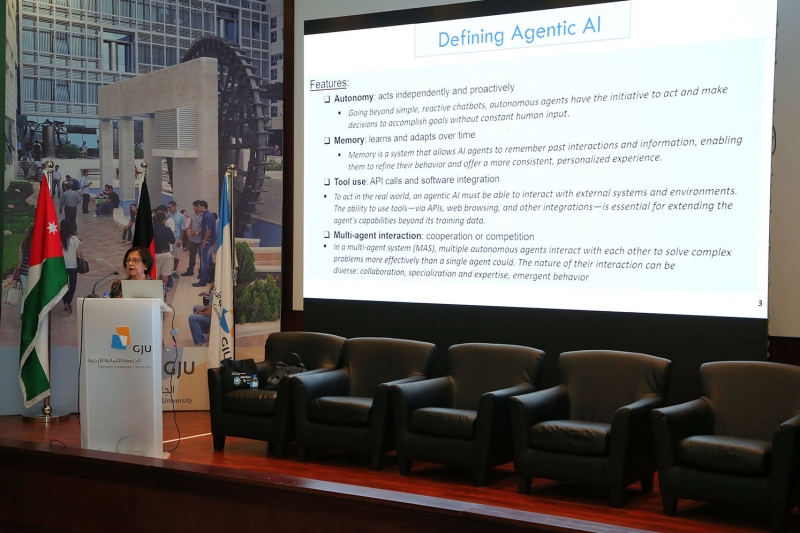
As part of the Future Tech Summit 2026, the German Jordanian University (GJU) organised the International Conference on Future Technologies (ICFT 2026), bringing together researchers, academics and experts from local and international universities, research institutions and industries. The conference aims to showcase the latest technological developments and strengthen collaboration across academia, research and industry.
Over three days, the conference explores emerging technology trends and the potential for developing practical applications through a diverse scientific programme featuring keynote lectures, research sessions and specialised panel discussions. Key topics include artificial intelligence and advanced computing, robotics and autonomous systems, semiconductors and microelectronics, the Internet of Things and cybersecurity, biomedical engineering and digital health, smart energy and energy storage, financial technology and digital transformation.
The conference emphasises bridging scientific research and practical applications by providing researchers, experts and industry representatives with opportunities to discuss technological needs and explore joint research projects. These efforts aim to translate scientific findings into innovative applications and solutions that address the needs of various sectors.
The keynote speeches and specialised sessions addressed a range of advanced topics, including AI agentic security and safeguarding the next generation of autonomous systems; the education revolution and talent ecosystem in the era of embodied AI; the transition from generative AI to deliberative AI and the next generation of intelligent systems; and autonomous agents and networked systems. Discussions also explored entrepreneurship as a core university mission through the MIT Sandbox model, the AI-driven hospital of the future and its associated opportunities and challenges, and the silicon carbide ecosystem for advanced electronic systems.
The programme also featured a special session titled “Real-World AI in a Cancer Centre: The KHCC Experience,” examining the use of AI in healthcare, as well as a special session on the future of food systems in light of AI. Other activities included a panel session with the Jordan Design and Development Bureau (JODDB) and a tutorial covering the foundations, technologies and future directions of quantum communications, quantum AI and quantum-safe cybersecurity in the quantum computing era. Parallel sessions also provided opportunities to explore specialised research and technology topics.
The conference also witnessed the signing of memoranda of understanding and research matching funds agreements involving GJU, Al Hussein Technical University (HTU) and Kuwait College of Science and Technology (KCST), as well as research matching funds agreements with Brazil and a memorandum of understanding with Power-IP to establish a joint company. These agreements support joint research funding and aim to strengthen research and technological cooperation between academic institutions and industry.
The conference also provides early-career researchers and postgraduate students with opportunities to present their research and discuss their findings with experts and specialists. This exchange supports the development of their research skills, expands their academic networks and opens up new opportunities for scientific and professional growth.
The conference reflects GJU’s commitment to supporting applied scientific research and strengthening academic and industrial cooperation at both the national and international levels, contributing to the development of innovative technological solutions and the application of scientific knowledge to support development.