

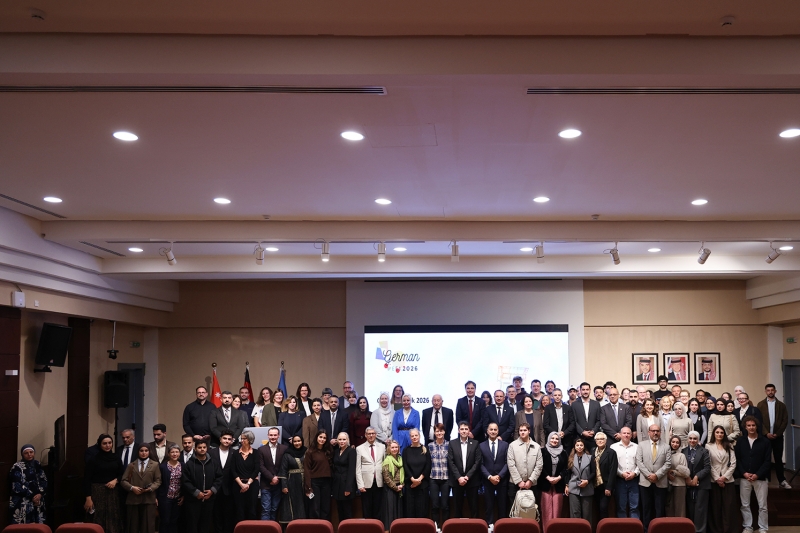
 The German Jordanian University (GJU) launched the activities of German Week 2026 on Sunday under the theme "Building Bridges. Shaping Futures.” The opening ceremony was attended by Chairman of the GJU Board of Trustees, Eng. Othman Bdeir; GJU President, Prof. Ala’aldeen Al-Halhouli; representatives of the German Embassy in Jordan and the German Academic Exchange Service (DAAD); students from GJU’s partner universities in Germany; representatives of German universities and institutions; the University's partners; and members of its academic and administrative staff and student body.
The week aims to highlight the University's journey and achievements while strengthening academic and cultural cooperation between Jordan and Germany.
In his opening remarks, GJU President Prof. Ala’aldeen Al-Halhouli emphasized that the University continues to develop its educational model, which is based on applied education and draws on the German experience. This approach promotes innovation, connects educational outcomes with the needs of the labor market and industrial sector, and helps prepare graduates with the skills needed to adapt to future changes.
Al-Halhouli highlighted the University's development and growth, noting that its student population has exceeded 6,000, its academic staff comprises 329 members, and the number of its graduates has surpassed 10,000, with an employment rate of more than 92%. He also referred to the expansion of academic programs and specializations, as well as the development of the University's innovation, scientific research, and entrepreneurship ecosystem through the Deanship of Innovation, Technology Transfer and Entrepreneurship (DI-TECH) and the Technology, Research and Innovation Park (TRIP), which provides a platform for collaboration between the University and the industrial sector.
Regarding the University's future directions, Al-Halhouli explained that its priorities focus on keeping pace with digital transformation and artificial intelligence applications, as well as developing the Smart University model. He also highlighted the success of the Future Tech Summit 2026, which brought together participants from 23 countries and contributed to exchanging expertise and building partnerships. He announced that the next edition will take place from 26 to 29 September 2027.
Al-Halhouli also spoke about the University's heritage building in Amman, which formerly served as the first premises of the British Embassy in Jordan. He explained that the University acquired the building last year and is working to develop it to accommodate the Consultancy and Training Center (CTC) and graduate studies, in addition to providing spaces for hosting and incubating companies. This development supports the University's internationalization, innovation, and entrepreneurship goals.
For his part, Vice President for International Affairs, Prof. Ralf Roßkopf, explained that building bridges lies at the heart of the University's mission, reflected in its German Year program and a network of more than 120 partner universities, alongside its cooperation with German companies and industrial institutions. These partnerships provide students with opportunities for academic exchange and practical training, open up professional prospects for graduates, and support joint projects, knowledge exchange, and the University's growing presence in Germany.
Roßkopf also highlighted the Syrian Innovation in Academia (SyrIA) project, launched in March 2026 and implemented by GJU with funding from the German Academic Exchange Service (DAAD) and the German Federal Foreign Office. The project aims to support the development of higher education in Syria and strengthen its links with international academic networks.
He also invited participants to attend the First German-Jordanian Future Universities Conference, which GJU will host on Wednesday, 18 November, under the title “Future Skills Require Future Universities.” The conference will address the future of higher education, the skills required for the future, and the role of artificial intelligence in university administration, education, and teaching.
Meanwhile, Prof. Claudia Fülle, Vice President for International Affairs and Equal Opportunities at Magdeburg-Stendal University of Applied Sciences, highlighted the role of the German Project Office of the German Jordanian University in Germany in following up on institutional cooperation, supporting students during their German Year, and strengthening communication with graduates, academics, and industrial partners.
Fülle noted that approximately 10,000 students have completed their German Year in Germany since the University's establishment, studying at more than 120 partner universities, most of which are universities of applied sciences, in addition to undertaking practical training at German companies. Approximately 800 students participate in the program annually. She also shared one of GJU graduates' success stories in Germany and invited participants to an upcoming event in Magdeburg in early June 2027, featuring a cooperation conference and a meeting of GJU Alumni Ambassadors.
Highlighting the human dimension of the partnership between the two countries, German Week Coordinator Prof. Dhiah el Diehn Abu Tair expressed his appreciation to the partners and colleagues visiting from Germany. He emphasized that GJU represents a shared space that extends beyond education and work to foster lasting human and academic relationships.
Abu Tair noted that building bridges does not mean eliminating differences between cultures and societies; rather, it is founded on dialogue, understanding, and mutual respect. He highlighted the importance of academic partnerships and student exchange in promoting solidarity and peaceful coexistence. He also called for making the most of German Week to expand engagement, establish joint projects, and discuss the impact of technological developments, particularly artificial intelligence, on the future of universities and approaches to teaching, learning, and scientific research. He stressed the importance of keeping pace with these transformations through curiosity, responsibility, and openness, while preserving the University's role as a space for belonging and human interaction.
Dean of the School of Applied Humanities and Social Sciences, Prof. Haytham Al-Thawbih, delivered a presentation on the project “Empowering Learning Through German Language Education,” implemented by the School with the support of the German Embassy. He highlighted its key activities, which included organizing a language camp for 40 students, training courses for 35 female students from a military school, and educational and interactive activities that benefited approximately 1,000 new GJU students. The project also provided practical training opportunities for master's students in German language education.
For her part, Nadia Shuqair, DAAD representative, emphasized the importance of knowledge and cultural exchange in strengthening academic relations between the two countries. She noted that GJU represents a model of international partnership and, through its applied education approach and network of relations, contributes to preparing students to keep pace with future transformations, particularly in digitalization, artificial intelligence, and climate change.
Director of the International Affairs Department, Humda Qamar, addressed the importance of international education in enabling students to rediscover themselves and understand other cultures from different perspectives. She explained that building bridges does not mean making societies alike, but rather fostering understanding and respect despite differences.
Qamar also announced the launch of the “Sustainability in Action” program for the first time as part of German Week. The program brings together representatives from the Ministry of Environment, the Greater Amman Municipality, and the Jordanian-German Society to discuss environmental issues, including waste management, climate change, composting, sustainable tourism, heritage preservation, and the challenges of water supply in Jordan. She also invited attendees to visit the “Peace Walk,” learn about partner institutions and their initiatives, and take part in the accompanying activities.
GJU alumna Hanan Qaraghuli, who graduated with a bachelor's degree in Architecture in 2016, shared her academic and professional journey, beginning with her participation in a student exchange program in Würzburg, Germany, in 2015, followed by moving to Berlin to pursue a master's degree in Urban Development, and eventually working in the technical sales sector. She highlighted how studying in Germany strengthened her independence and broadened her horizons, as well as the role of international education in opening new academic and professional pathways for students.
GJU students Lujain Khalil and Ammar Al-Mali also introduced NextGen GJU, a Jordanian-German student-led platform aimed at promoting youth participation in public life through dialogue, applied learning, and cooperation between the two countries, in line with His Majesty King Abdullah II's vision for political modernization and youth empowerment. They presented the initiative's objectives and activities during German Week, including “Next Gen Passports” and a discussion session on parliamentary diplomacy, higher education, and opportunities available to young people.
German Week activities will continue until 19 November, featuring a diverse program of academic, cultural, and interactive activities. These include meetings with German organizations and institutions and partner universities; exhibitions showcasing the University's projects and initiatives; an Open Day for school students; workshops and competitions in German language, artificial intelligence, programming, cybersecurity, engineering, and health sciences; discussion sessions on Jordanian-German relations and youth opportunities; and activities focusing on sustainability and climate change. The program also features the First German-Jordanian Future Universities Conference, sports and student activities, the School of Architecture and Built Environment exhibition, a heritage tour of GJU's Jabal Amman Campus, the closing ceremony, and a German film evening in cooperation with the Goethe-Institut.
The organization of German Week reaffirms the depth of the Jordanian-German partnership and GJU's role in strengthening cooperation in education, scientific research, and cultural exchange, while opening new avenues for partnerships between academic institutions and various sectors in both countries.