

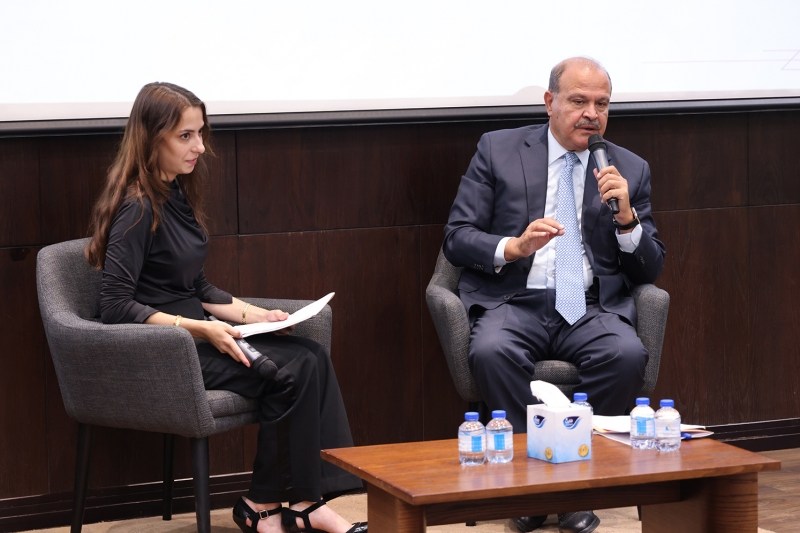
 The German Jordanian University (GJU), represented by the Deanship of Student Affairs (DSA), launched on Sunday the “RAWAFED” initiative under the theme “Youth for Identity, Dialogue, and Social Cohesion,” in the presence of His Excellency Senator Hussein Hazza Al-Majali, President of GJU Prof. Ala’aldeen Al-Halhouli, GJU students, and several members of student councils from Jordanian universities.
The launch ceremony featured a dialogue session titled “Social Cohesion and Political Modernization: Two Pillars of a Strong Jordan,” with Senator Hussein Hazza Al-Majali as the guest speaker. The session addressed a number of issues related to youth participation in public life, Jordanian national identity, political modernization, and the challenges facing social cohesion amid digital transformation and the widespread use of social media.
Senator Al-Majali said that social cohesion is a cornerstone of stability and state strength, explaining that differences in opinion should not lead to hostility, but rather should be managed through dialogue, respect for the law, and acceptance of others’ views, while rejecting hate speech and rumors. He noted that a state’s strength is measured not only by the strength of its institutions, but also by its ability to preserve social cohesion, pointing out that social cohesion and political modernization are interconnected processes.
He noted that political modernization in Jordan and the role of youth represent two key pillars in building the future, explaining that modernization is not limited to elections or increasing the number of political parties, but also requires a transformation in political culture and practice, moving from personality-based politics toward politics based on programs and ideas. He highlighted the important role of universities in preparing a generation capable of dialogue, leadership, and assuming responsibility, while empowering young people to participate, take initiative, and contribute to decision-making, as well as strengthening their role in confronting hate speech and polarization.
Senator Al-Majali also addressed the importance of a unifying national identity and the balance between security, stability, modernization, and participation, explaining that social, cultural, and intellectual diversity can be a source of strength when Jordanians come together around shared national principles. He called for respecting differences and preventing them from turning into social division, stressing that a strong Jordan is built on a cohesive society, effective institutions, political participation, and aware and engaged youth. He added that managing differences through dialogue and the law, while involving young people in shaping their future, strengthens Jordan’s resilience, stability, and national strength.
Senator Al-Majali also listened to a number of questions raised by GJU students and members of student councils from several Jordanian universities. The questions addressed youth participation in political modernization, the limits of freedom of expression, the role of educational and security institutions in safeguarding social cohesion, and the future of youth participation in public life.
For her part, Dean of Student Affairs Dr. Farah Al-Atrash said that the GJU should serve as a genuine space for dialogue, personal development, and fostering citizenship, noting that the “RAWAFED” initiative seeks to create broader opportunities for young people to think, participate, and assume responsibility, while preparing a generation to become genuine partners in the process of modernization and shaping the future.
The “RAWAFED” initiative serves as a youth platform for dialogue, impact, and joint action, aiming to empower young people and engage them in national issues, promote active citizenship, national identity, and social cohesion, and support their participation in public life and political modernization.