

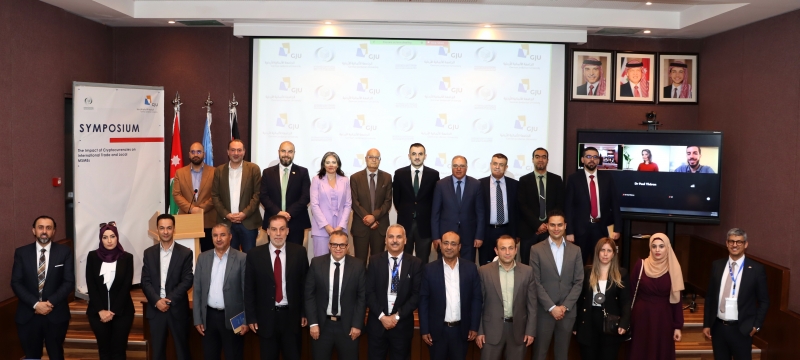
Representing the Minister of Higher Education and Scientific Research, Chairman of the Jordanian National Committee for Culture and Science, the Secretary General of the Ministry, Prof. Mamoun Al-Dubei, commenced the international scientific symposium organized by the GJU in cooperation with the Islamic World Organization for Education, Science and Culture, under the title of cryptocurrencies and their impact on international trade and MSMEs, with the participation of international experts and participants, physically and remotely.
Al-Dubei stated that although digital currencies may provide many advantages compared to traditional payment methods, decision-makers must address the challenges arising from using them, pointing to the importance of digital currencies as a modern technology in trade and its impact on international trade and MSMEs, as they will play significant role in changing the future.
Meanwhile, the President of the University, Prof. Ala’aldeen Al-Halhouli, stated that the symposium is a unique opportunity for participants and students to learn from experts in the business world and to get a clearer picture of the opportunities and challenges resulting from the use of cryptocurrencies, indicating that students are the future in the business world and it is necessary for them to be aware of the latest developments in the finance world, especially digital and cryptocurrencies, which is a global phenomenon that changes the way we think and how we manage financial transactions.
The representative of ISESCO, Prof. Dr. Adel Smeida, stated that the emergence of cryptocurrencies has reshaped the global financial scene and challenged the traditional models of financial exchange in general. It is also a huge leap in how we conduct and manage financial transactions, including the implications for international trade and the empowerment of MSMEs.
While the conference coordinator, Prof. Dr. Malik Al-Sharari, indicated that the symposium programm, in which former Deputy Prime Minister Dr. Jawad Al-Anani and experts from Jordan, Qatar, Germany, France, Lebanon and Egypt participated, included three main and important axes. First one, the financial stability and digital currencies issued by central banks and their role in ensuring financial stability, second one, dealt with cryptocurrency technology and smart contracts, including cryptocurrencies, innovation, cryptocurrencies, cross-border payments, investment in cryptocurrencies, distinguishing facts from fiction and the role that cryptocurrencies can play, as for the last one, it included cryptocurrencies, crime, and the future of cryptocurrencies between challenges and prospects.