

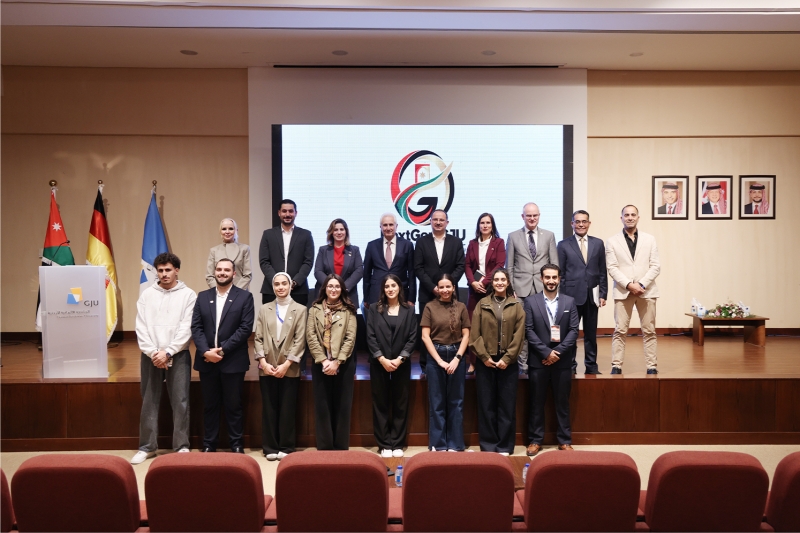
 As part of German Week 2026 at the German Jordanian University (GJU), the Jordanian-German Initiative for Political Education and Youth Engagement (NextGen GJU), affiliated with the Deanship of Student Affairs, organized a dialogue session entitled “Jordanian-German Relations: Parliamentary Diplomacy, Higher Education, and Opportunities for Youth.”
The session featured H.E. Senator Dr. Wajih Owais, Ms. Lina Graziano, Head of the Culture and Media Department at the German Embassy, and Dr. Bader Al-Madi, political expert and academic at GJU. It was moderated by Daad Nazzal, the Initiative’s Coordinator.
Dr. Owais reviewed the development of Jordanian-German relations and the consolidation of the strategic partnership between the two countries. He highlighted the expansion of cooperation to include higher education, vocational training, scholarships offered by the German Academic Exchange Service (DAAD), support for Syrian refugees, and projects in the water sector.
He described GJU as a success story in higher education, highlighting its educational model, which combines academic knowledge with practical application and provides students with opportunities for training at German companies, thereby enhancing their readiness for both the Jordanian and German labour markets. He also stressed the importance of advancing bilateral relations towards a strategic partnership based on mutual interests and benefits, making use of qualified Jordanian professionals to meet the needs of the German labour market, particularly in the healthcare sector. He further highlighted the importance of strengthening German language education and developing formal pathways to qualify Jordanian professionals for employment in Germany.
For her part, Ms. Graziano affirmed the strength of Jordanian-German relations and the importance of continuing cooperation in higher education, vocational training, scientific research, and youth empowerment, creating broader opportunities for young people to learn and exchange expertise. She also highlighted the importance of expanding youth participation in political life and providing young people with meaningful opportunities to contribute to decision-making. In this context, she presented findings from a study examining young people's attitudes towards party and political participation. She emphasized the need to develop dialogue, research, and civic engagement skills, while promoting mutual understanding among young people through cultural and linguistic exchange.
Meanwhile, Dr. Al-Madi addressed the political, economic, and developmental dimensions of Jordanian-German relations, explaining that they are based on four main pillars: political trust, economic cooperation, development assistance, and shared interests in promoting regional and international stability. He highlighted the importance of continuous communication, high-level reciprocal visits, and the exchange of political expertise, referring to Jordan's participation in international meetings and conferences, including the Munich Security Conference. He also discussed Germany's role in preparing for the EU-Jordan Investment Conference, describing it as an opportunity to strengthen investment cooperation and move towards more sustainable economic partnerships, alongside continued cooperation in development and capacity-building.
In her introduction to the session, Daad Nazzal noted that the event coincided with the 73rd anniversary of the establishment of diplomatic relations between Jordan and the Federal Republic of Germany. She also recalled His Majesty King Abdullah II's message in the German city of Münster on the role of youth in promoting peace, emphasizing the importance of translating this message into active participation in advancing bilateral cooperation.
In his opening remarks, Vice President for International Affairs, Prof. Ralf Roßkopf, affirmed that Jordanian-German relations extend beyond formal and institutional cooperation, relying on building trust between societies and preparing generations capable of sustaining and developing this partnership. He highlighted the pivotal role of parliamentary diplomacy and universities in strengthening connections between peoples and preparing qualified individuals to carry these relations forward.
He added that GJU represents a model of partnership founded on the belief that education is among the most sustainable forms of cooperation. He encouraged students to engage in dialogue, ask questions, discuss different issues with respect and responsibility, and actively participate in shaping the future of their societies.
For his part, Dean of Student Affairs, Dr. Omar Al-Batayneh, emphasized that Jordanian-German relations have a direct impact on GJU students' educational and personal experiences through study and training opportunities in Germany. These experiences expose students to diverse cultural and professional environments while strengthening their independence, self-confidence, and ability to work in multicultural settings.
He explained that such experiences, together with student activities and teamwork, contribute to developing students' dialogue and listening skills, respect for different perspectives, and ability to work collaboratively. He encouraged students to make the most of these opportunities and contribute their ideas and initiatives to furthering cooperation between the two countries.
Additionally, Hashim Sawalha, a member of the Initiative's team, delivered an introductory presentation outlining NextGen GJU's objectives and activities, which aim to promote political awareness, critical thinking, and civic engagement among young people. These activities include workshops, seminars, and political simulations, as well as connecting scientific research with policymaking through the “Science to Policy” pathway.
He also highlighted the key topics addressed by the Initiative, including political modernization, media, misinformation, and civic participation, alongside developing students' skills in dialogue, debate, negotiation, and public speaking. The Initiative also introduces students to international exchange opportunities, scholarships, and leadership programmes.
The session witnessed active engagement from students, who participated in the discussion and raised questions about the future of Jordanian-German relations, the role of youth in strengthening them, and the importance of political and civic participation in building more open societies that embrace dialogue. The event concluded with an introduction to the “NextGen Passport” activity, which offered students an opportunity to learn more about the Initiative and its activities and explore areas of cooperation between Jordan and Germany.
The session forms part of GJU's ongoing efforts to enhance students' political awareness, expand their participation in discussions on national and international issues, and strengthen the Jordanian-German partnership by connecting education, diplomacy, and youth opportunities, while promoting the role of younger generations in shaping the future of this partnership.