

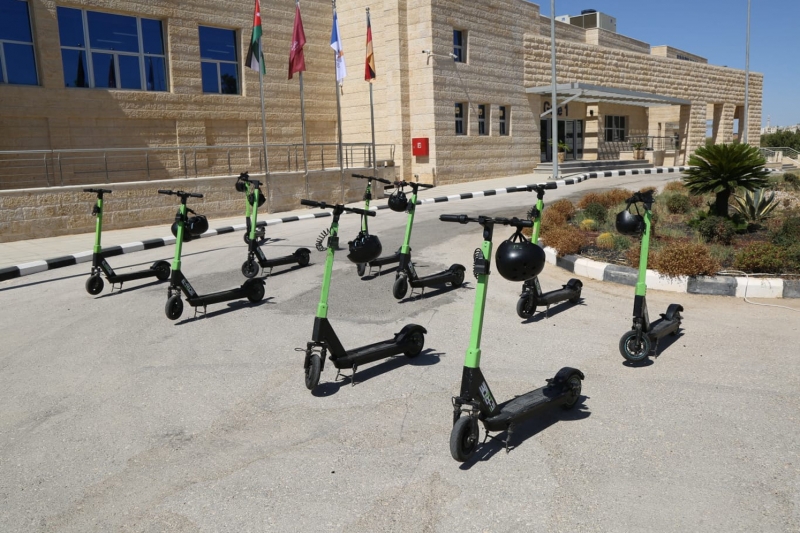
 Dr. Aladdin Halhouli, President of the German Jordanian University (GJU), has announced significant initiatives aimed at promoting sustainability on campus. Over the past year and a half, GJU has integrated sustainability as a core component of its operations, implementing several projects in this context.
Dr. Halhouli explained that the university has started transitioning its vehicles to electric cars, with the first two electric cars delivered three weeks ago. The sustainability efforts also include fostering an institutional culture that raises awareness about the importance of sustainability among students and staff.
Furthermore, students have formed a sustainability team and club. Among their proposals was the use of electric scooters (E-Scooters). An agreement has been reached with E-Ride to be the first to introduce electric scooters on campus, allowing students and staff to use them.
The university president mentioned plans to invest further in sustainability projects, including providing the necessary infrastructure for using electric bikes (E-Bikes) and other sports facilities on campus. He emphasized that this partnership with E-Ride aims to create tangible benefits for the country, with the hope that this experience will be adopted by other Jordanian universities.
These initiatives are part of GJU’s vision to enhance environmental sustainability and offer innovative solutions to contemporary environmental challenges.
Captain Hussam Dawood, Founder and CEO of E-Ride, expressed his great joy at this important achievement and explained that E-Ride specializes in renting electric scooters and bikes as a means of transportation and recreation. He proudly announced the launch of a sustainable mobility project within the GJU campus.
Dawood pointed out that GJU is the first university in Jordan to adopt this project, using electric scooters as a means of transportation on campus. He added that the company is honored to be part of the university’s vision to promote sustainability and provide environmentally friendly transportation solutions.
Dawood emphasized the importance of small-scale mobility solutions, such as electric scooters and bikes, in achieving environmental sustainability. These can serve both the recreational and transportation sectors, being used in parks, youth cities, and sports facilities for recreation, and in private and public universities for practical transportation.
He noted that this step will help build a new culture among youth, highlighting the benefits of these means as alternatives to traditional transportation, which emit carbon gases. The use of small electric vehicles also contributes to reducing costs and improving transportation quality, thereby enhancing environmental sustainability.
Dawood confirmed that the company is ready to provide these services to all private and public universities, considering this step as the first in building a new culture reliant on electric bikes and scooters. The second phase will involve applying these means on public streets once the laws permit and infrastructure improvements are made to accommodate such projects, with plans to expand to other governorates.
In conclusion, Dawood expressed his hope for a successful and sustainable partnership that contributes to improving the environment and providing innovative and safe transportation means for students and staff in Jordanian universities. He affirmed that this initiative paves the way for more sustainable environmental initiatives in various educational institutions across Jordan