

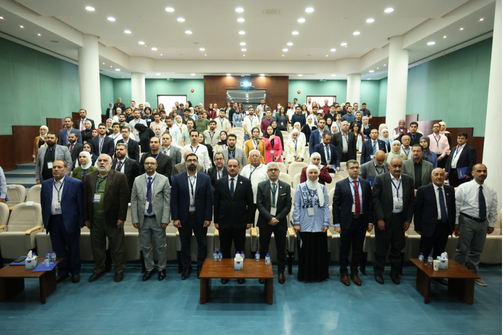
 The School of Applied Medical Sciences (SAMS) at the German Jordanian University organized its Research and Innovation Day 2026 on Wednesday, 12 August 2026. The event was organized in cooperation with the IEEE Engineering in Medicine and Biology Society Jordan Chapter (IEEE EMBS Jordan Chapter) under the theme “From Research to Impact: Connecting Discovery, Application, and Collaboration.”
The event attracted nearly 300 participants, including researchers and academics from Jordanian universities across the Kingdom, as well as faculty and administrative staff, students, experts, and representatives of more than 15 companies and institutions. More than 40 scientific and research posters were presented, while strong attendance and engagement continued until the conclusion of the program.
The event placed particular emphasis on translating research outcomes into practical applications and adoptable solutions for the healthcare and industrial sectors. Discussions highlighted the technical, regulatory, and commercial pathways required to transform innovations into real-world impact, while underscoring the importance of collaboration among universities, industry, and supporting organizations to accelerate knowledge and technology transfer and generate sustainable economic and societal value.
GJU President Professor Ala’aldeen Al-Halhouli emphasized that the true value of scientific research lies in its capacity to create a tangible impact on society and the economy, and to transform knowledge and innovation into practical solutions that address challenges and advance development. He also highlighted the importance of localizing technology and strengthening partnerships between the University and the industrial and productive sectors to support the transfer, development, and local application of knowledge. He noted that GJU established the Deanship of Innovation and Technology Transfer, alongside the Technology, Research and Innovation Park, to provide an institutional environment that nurtures ideas and projects and supports the transformation of research outcomes into technologies and products with sustainable impact.
Dean of the School of Applied Medical Sciences Dr. Ziad Abu El-Rub explained that the Research and Innovation Day provides a platform that brings together researchers, students, experts, and industry representatives to showcase research and applied projects, exchange knowledge, and explore opportunities to develop ideas into practical solutions. He added that the event reflects the School’s interdisciplinary identity, which integrates engineering, medical and pharmaceutical sciences, and technology. It also contributes to strengthening academic and industrial partnerships. Professor Abu El-Rub expressed his aspiration for the Research and Innovation Day to become an annual event that promotes a culture of applied research and innovation across the University.
The program began with an opening ceremony moderated by Dr. Nafisah Refai. It featured addresses by the Chair of the Organizing Committee, the Dean of the School of Applied Medical Sciences, guest of honor Professor Asaad Yousef Asaad, President of the Islamic University of Gaza, and the President of the German Jordanian University. The ceremony was followed by the opening of the scientific poster exhibition and participating companies’ booths.
Dr. Mohammad Hajjiri, Consultant Cardiologist specializing in cardiac electrophysiology and interventional catheterization, delivered the keynote address titled “From Research to Impact: Clinical Innovation, Medical Technologies, and Patient-Centered Translation.” He discussed how clinical needs, healthcare challenges, and research ideas can be translated into practical medical technologies and solutions. He also underscored the importance of multidisciplinary collaboration and placing patients’ needs and quality of care at the heart of research and innovation.
The program also featured a presentation by Dr. Sameer Hasan on biomedical engineering innovation, during which he reviewed key developments in medical devices, artificial intelligence, and digital health, and their role in improving healthcare.
Dr. Fouad Darras delivered a presentation on intellectual property in the pharmaceutical industry and its role in protecting innovation, promoting investment, and facilitating market access. Dr. Anas Al-Shishani addressed the stages of pharmaceutical product development, from formulation and laboratory work through manufacturing and quality assurance to regulatory compliance.
A main panel discussion titled “From Research to Translation: Technical, Regulatory, and Commercial Pathways” brought together Dr. Saja Hamed, Eng. Yousri Haj-Yousef, and Eng. Safwa Almousa, and was moderated by Dr. Walid Al-Zyoud. The panel addressed technology validation, quality assurance, regulatory requirements, intellectual property protection, product development and commercialization, and partnerships between universities and industry.
The scientific poster exhibition enabled students and researchers to present more than 40 scientific posters and research projects were presented before a specialized judging committee and discuss their work with experts and representatives of participating sectors. The program also included student-company engagement activities and short workshops focusing on internships, employment opportunities, graduation projects, field visits, and joint research.
The event received sponsorship from the Jordanian Pharmaceutical Manufacturing Company, Al-Shaker Scientific and Medical Supplies, and ZONETECHS, reflecting the importance of partnerships between the University and the private sector in supporting scientific research and innovation.
The event concluded with the recognition of speakers, evaluators, sponsors, participating organizations, and presenters of outstanding scientific posters. Faculty and administrative staff, students, researchers, and representatives of participating institutions and companies attended the closing ceremony. The event also received media coverage from Jordan Television.