

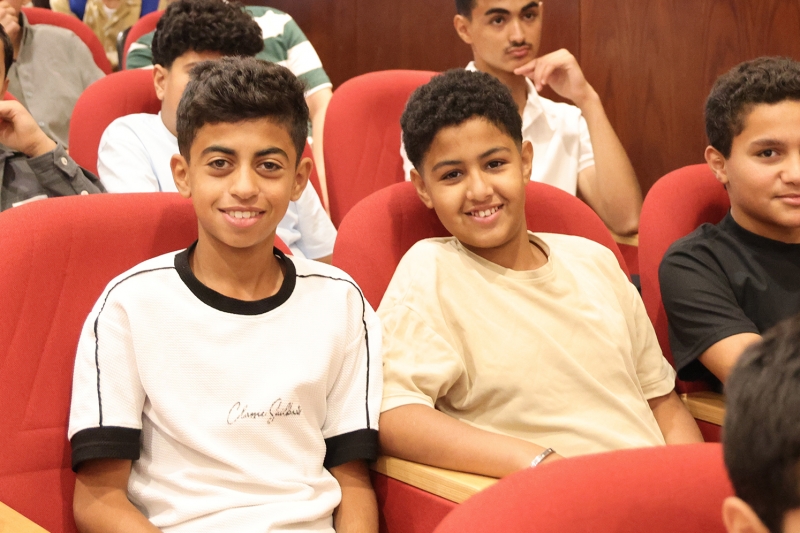
 The German Jordanian University (GJU), through its Deanship of Student Affairs, organized the fifth edition of its Children's University: Little Professor program, bringing together more than 300 children from across the Kingdom. The initiative reflects the University's ongoing commitment to fostering a culture of learning and innovation while nurturing young people's interests in science, engineering, and technology from an early age.
The program aims to provide an interactive learning environment that develops participants' analytical thinking, scientific inquiry, and problem-solving skills, while also strengthening communication, leadership, and self-confidence. Through these experiences, the program seeks to prepare a generation capable of innovation and equipped to meet the challenges of the future.
During the opening ceremony, GJU President Prof. Dr. Ala'aldeen Al-Halhouli emphasized that the initiative is inspired by leading German academic models and reflects the University's vision of investing in people from an early age. He noted that the program encourages children's scientific curiosity, inspires exploration, and helps them build ambitious academic aspirations.
For her part, Dean of Student Affairs Dr. Farah Al-Atrash explained that the program welcomes children between the ages of 12 and 16 from across Jordan. Participants engage in lectures and hands-on activities supervised by GJU faculty members, in addition to introductory sessions in the German language, further strengthening their connection to the University's unique academic identity.
The opening ceremony also featured the success story of Maha Al-Shawabkeh, one of the program's graduates, who was awarded a full scholarship to study at GJU after achieving outstanding results in the General Secondary Education Certificate Examination (Tawjihi). Her achievement stands as a testament to the program's role in motivating young students to pursue academic excellence.
The program runs over several weeks and includes practical workshops, interactive activities, and applied lectures in science, engineering, technology, and innovation. Together, these activities provide participants with an engaging educational experience that simulates university life while fostering their scientific knowledge, creativity, and passion for lifelong learning.