

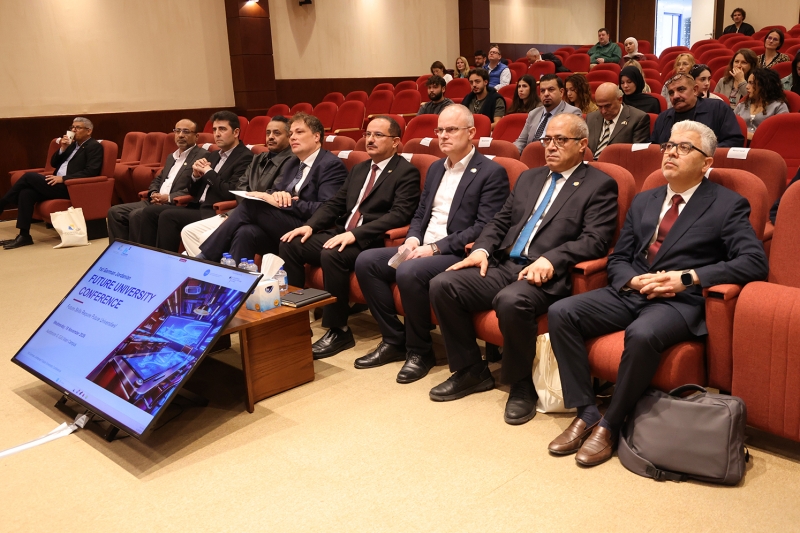
 The German Jordanian University (GJU) hosted the 1st German Jordanian Future University Conference under the theme “Future Skills Require Future Universities”, as part of German Week 2026. The conference brought together academics, experts and representatives of higher education institutions from Jordan and Germany.
The conference was opened by Prof. Dr. Ala’aldeen Al-Halhouli, President of GJU, who delivered a speech highlighting the importance of developing the higher education system in response to rapid global transformations, particularly in artificial intelligence, digitalisation and labour market needs. He noted that the Jordanian-German partnership lies at the heart of the University's identity and has contributed to building an applied education model that connects academic knowledge with practical experience. He also raised questions about the future of universities, their roles and teaching methods amid these transformations, stressing the importance of developing educational models that respond to students' abilities and interests while strengthening critical thinking, creativity and innovation.
For his part, Mr. Martin Lohr, Cultural Attaché at the German Embassy in Amman, emphasised the importance of GJU as a model of close partnership between Jordan and Germany, highlighting its role in promoting academic exchange, providing opportunities for young people and building sustainable ties between the two countries. He also addressed the transformations artificial intelligence is bringing to knowledge, education, creativity and the role of universities, stressing the importance of equipping young people with the skills needed to navigate change, think critically, adapt to challenges and develop creative solutions to complex problems.
In turn, Prof. Dr. Ralf Roßkopf, Vice President for International Affairs at GJU, introduced the conference theme, noting that the rapid development of artificial intelligence requires universities to formulate clear strategies for engaging with these technologies and examining their implications for higher education institutions. He emphasised the importance of fostering dialogue and collective reflection among university communities on how to respond to these transformations, moving beyond simply using AI applications towards determining how they should be deployed and how their impact on the future of higher education should be addressed.
The conference programme was organised into four main sessions. The first addressed the future of higher education, while the second focused on the impact of artificial intelligence on future universities. The third featured four parallel workshops, and the fourth was dedicated to presenting the workshops' outcomes and discussing their key findings.
During the first session, Prof. Dr. Ala’aldeen Al-Halhouli presented GJU's Competence Matrix, developed as a central component of students' educational journey. The matrix comprises 25 competencies across five main areas: digital and AI literacy; cognitive and analytical practices; creativity and innovation; communication and collaboration; and self-management and professional skills. He also discussed how these competencies are integrated into study plans, courses and extracurricular activities to enhance graduates' readiness for the labour market and support their entrepreneurial aspirations.
Dr. Anna Sandmeir, Program Manager at Stifterverband für die Deutsche Wissenschaft e. V., delivered a presentation on the concept of future skills and the framework developed by the organisation to identify the competencies required in the coming years. She outlined the methodology used to identify these skills based on megatrends and societal and technological transformations, highlighting the importance of developing competencies that extend beyond labour market requirements to include active participation in society.
Assoc. Prof. Dr. Ziad Abu El-Rub, Dean of the School of Applied Medical Sciences (SAMS) at GJU, presented the University's Micro-Credential Strategy and its significance for higher education. He highlighted the role of micro-credentials in providing flexible learning pathways that respond to rapidly changing labour market skills, enabling learners to acquire specific competencies through short programmes subject to assessment and quality assurance. This approach supports lifelong learning and complements traditional academic pathways.
Prof. Dr. Judith M. Pütter and Prof. Dr. Jessica Stemann of Hamm-Lippstadt University of Applied Sciences presented the International Network for Future Universal Skills Education (INFUSE), which aims to strengthen international academic cooperation and integrate future skills into education. The network does so through joint projects bringing together students from different cultural and academic backgrounds, helping them develop critical thinking, communication and teamwork skills, while addressing challenges related to artificial intelligence and sustainability.
The first session concluded with a panel discussion on the future of universities, featuring Dr. Anna Sandmeir, Prof. Dr. Dietmar Wolff of Hof University of Applied Sciences, and Assoc. Prof. Dr. Ziad Abu El-Rub of GJU. The discussion was moderated by Asst. Prof. Dr. Mayada Daibes, Dean of the School of Nursing at GJU. Participants discussed the transformations taking place in higher education, the future of academic programmes, the skills students need to develop and the role of universities in keeping pace with technological advancements.
The second session, moderated by Prof. Dr. Ralf Roßkopf, Vice President for International Affairs at GJU, focused on the impact of artificial intelligence on future universities. The presentations examined universities in the political economy of generative AI, national approaches to integrating AI applications into higher education, the implications of AI for university management and administration, and the transformations taking place in traditional teaching and learning methods.
The session featured presentations by Prof. Dr. Christine Huth-Hildebrandt of GJU; Prof. Dr. Christoph Lattemann of Constructor University Bremen; Prof. Dr. Jörg Müller-Lietzkow, President of HafenCity University Hamburg; and Prof. Dipl. Des. Julia Schnitzer, Vice President for Studies and International Affairs at the Technical University of Applied Sciences Brandenburg.
The session also featured a panel discussion on the future of higher education in the age of artificial intelligence, with Prof. Dr. Jörg Müller-Lietzkow, Prof. Dipl. Des. Julia Schnitzer, the Dean of the Faculty of Engineering at Yarmouk University, and Prof. Dr. Ala’aldeen Al-Halhouli, President of GJU.
The third session featured four parallel workshops held from 2:30 to 4:30 p.m. They addressed the use of artificial intelligence to advance higher education and teaching and learning methods, the development of institutional guidelines supporting its use, and the future of education and academic assessment.
The first workshop, led by Prof. Dr. Judith M. Pütter and Prof. Dr. Jessica Stemann of Hamm-Lippstadt University of Applied Sciences, focused on moving from uncertainty to developing supportive strategies for teaching and learning through the LEGO Serious Play methodology. This approach enabled participants to explore future skills and experience interactive and participatory teaching and learning methods.
The second workshop, led by Prof. Dr. Paul Grimm of Darmstadt University of Applied Sciences and the European University of Technology, and Prof. Dr. Dhiah el Diehn I. Abou-Tair of GJU, addressed the development of supportive institutional guidelines for the use of artificial intelligence in teaching and learning. Participants discussed frameworks and principles for ensuring the responsible use of these technologies, with the aim of developing recommendations and an institutional action plan.
The third workshop, led by Prof. Dipl. Des. Julia Schnitzer and Dr. Katarzyna Wojcik of the Technical University of Applied Sciences Brandenburg, explored the future of higher education in the age of artificial intelligence. It examined prospective forms of learning and university work in 2036, the roles that humans and AI will assume, the skills required, and the boundaries that should be maintained in the academic environment.
The fourth workshop, led by Eng. Qatada Damra, Director of GJU's Center for eLearning and Academic Performance Improvement (CeLAPI), presented a local AI-assisted marking application for assessing students' work. The workshop examined its technical feasibility and alignment with pedagogical and ethical standards, as well as its potential to improve assessment efficiency and feedback while ensuring fairness, transparency and human oversight.
The conference concluded with the fourth session, moderated by Assoc. Prof. Dr. Farah Al-Atrash, Dean of the School of Architecture and Built Environment (SABE) at GJU. The session featured presentations of the outcomes of the four workshops and discussions of the main findings and recommendations. Prof. Dr. Ralf Roßkopf, Vice President for International Affairs at GJU, then delivered the closing remarks.
The conference forms part of GJU's efforts to strengthen Jordanian-German academic cooperation, exchange expertise and experiences in higher education development, and explore future directions that contribute to building universities better equipped to respond to knowledge and technological transformations and labour market needs.