

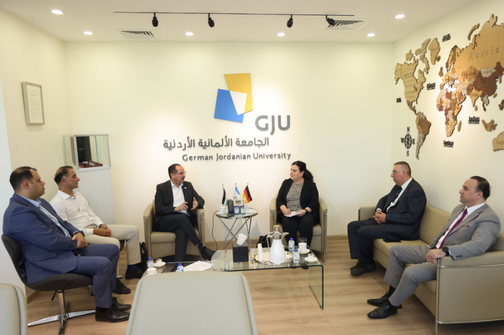
 The Food and Agriculture Organization of the United Nations (FAO) and the German Jordanian University (GJU) discussed ways to enhance joint cooperation in the development of academic curricula and the integration of climate change adaptation and sustainability concepts into educational programs, contributing to the preparation of qualified professionals capable of addressing future environmental challenges.
The discussions took place during a meeting hosted by the President of GJU, Prof. Ala’aldeen Al-Halhouli, with a delegation from FAO, in the presence of Prof. Aiman Al-Share, Dean of the School of Sustainable Systems Engineering (SSSE), and Prof. Osama Saadeh, Dean of Scientific Research (DSR).
The FAO delegation included Dr. Samia Akroush, Policy and Education Specialist at FAO; Dr. Ahmed Al-Salaymeh, Climate Change Specialist and FAO Advisor; and Dr. Luai Jraisat, Curriculum Development Advisor.
The visit comes within the framework of the project “Building Resilience to Cope with Climate Change in Jordan through Improving Water Use Efficiency in the Agriculture Sector (BRCCJ)”, implemented by FAO with support from the Green Climate Fund (GCF), in partnership with the Jordanian government and the United Nations Development Programme (UNDP). The project targets the governorates of Madaba, Karak, Tafila, and Ma’an.
The project aims to strengthen resilience to climate change by improving water-use efficiency in the agricultural sector through the development of more climate-resilient water systems, improving livelihoods and food security, and enhancing the integration of climate adaptation concepts into policies, institutions, the private sector, and civil society.
During the meeting, both parties reviewed the results of an analysis of the university’s engineering curricula, which demonstrated excellence in incorporating sustainability and environmental engineering concepts, in addition to offering advanced academic content in water and energy fields. Opportunities to further develop these curricula were also discussed to enhance students’ and graduates’ readiness to address climate challenges and sustainable development requirements.
Prof. Al-Halhouli emphasized that GJU continues its efforts to strengthen sustainability and climate action concepts within its academic and research systems, stemming from its commitment to supporting innovation and applied education linked to contemporary environmental and developmental challenges.
He further noted that cooperation with FAO represents an important step toward developing an educational environment more closely connected to climate change issues, contributing to the preparation of graduates equipped with the skills and knowledge necessary to support sustainable development pathways and enhance resilience to future climate challenges.