

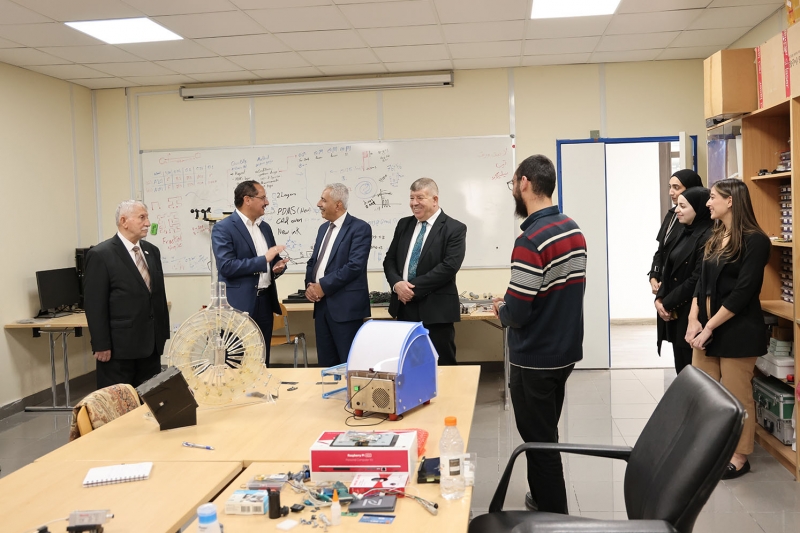
The President of the German Jordanian University, Prof. Ala’aldeen Al-Halhouli, received a delegation from Palestine Polytechnic University to discuss prospects for academic and scientific cooperation between the two universities, and to strengthen partnerships in the fields of education, training, and research and development particularly in modern technology, artificial intelligence, and cybersecurity.
The delegation from Palestine Polytechnic University was headed by the Chairman of the University’s Board of Trustees, Prof. Ahmad Saeed Al-Tamimi, and included the University President, Prof. Mustafa Abu Safa, along with the Vice President for Planning and Development, Prof. Ayman Sultan.
During the meeting, both sides explored opportunities for joint collaboration, especially in applied programs and engineering and technical disciplines. They emphasized the importance of exchanging expertise and faculty members, as well as implementing joint research projects that benefit students and the local communities in both countries. The focus was placed on innovation in AI, information technology, and cybersecurity solutions.
The visiting delegation also toured the university’s Technology, Research, and Innovation Complex, where they were introduced to projects and initiatives aimed at strengthening the university’s leadership in technology and scientific research, and contributing to scientific advancement and economic growth in the Kingdom.
Prof. Al-Halhouli affirmed the German Jordanian University’s commitment to expanding cooperation with leading Arab universities, praising the academic and research level achieved by Palestine Polytechnic University and its efforts to build effective partnerships with regional and international academic institutions.
For their part, members of the delegation expressed their gratitude for the warm reception and affirmed Palestine Polytechnic University’s aspiration to deepen collaboration with the German Jordanian University, in a way that contributes to advancing the educational process and enhancing the quality of academic outcomes—especially in light of the rapid challenges posed by digital transformation and ongoing developments in modern technology.