

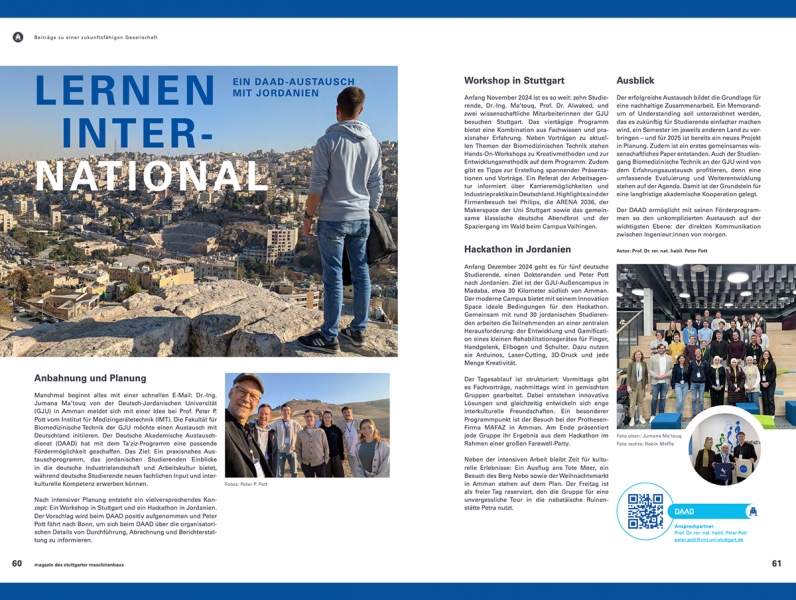
 The Mechanical Engineering Magazine at the University of Stuttgart, Germany, published an article about a distinguished academic exchange project between the German Jordanian University (GJU) and the University of Stuttgart, supported by the German Academic Exchange Service (DAAD).
This project falls within the framework of academic cooperation between GJU and the University of Stuttgart, through which a comprehensive student, academic, and research exchange program was implemented in November and December 2024, with support from DAAD under the “Ta’ziz” program, aimed at fostering international partnerships.
The collaboration began as an initiative by Dr. Jumana Ma’touq from GJU, who reached out to Prof. Dr. Peter Pott from the Institute of Medical Device Technologies at the University of Stuttgart to explore opportunities for the exchange of expertise and experience in the field of biomedical engineering. This collaboration resulted in the launch of a joint program designed to strengthen students’ technical and cultural competencies on both sides.
The program included a specialized academic workshop hosted at the University of Stuttgart, attended by ten students and faculty members from GJU. It featured lectures and hands-on workshops on biomedical engineering technologies, along with field visits to companies and innovation centers such as ARENA2036, the Philips Industrial Innovation Center, and university laboratories. Cultural activities were also organized to introduce students to German culture, including a guided tour of the Vaihingen Forest and a local food tasting experience.
In return, GJU hosted a technical "Hackathon" on its main campus in Al-Mushqar, where it welcomed a student delegation from the University of Stuttgart. Students from both universities worked in mixed teams to develop innovative technological solutions in the field of medical devices, utilizing technologies such as Arduino, 3D printing, and laser cutting. The program also included technical lectures and cultural excursions, including visits to Petra and Wadi Rum.
This academic exchange served as a rich experience on both scientific and cultural levels, contributing to mutual understanding and expanding the potential for future cooperation between the two institutions. Work is currently underway to prepare a memorandum of understanding between the universities and to submit a joint proposal under the Erasmus program, in addition to planning joint scientific publications involving students.
Both parties emphasized that this collaboration represents a successful model of cross-border academic exchange, with the DAAD program playing a key role in its success.
To read the published article in the magazine (pages 60, 61, and 70):Click here