Amman- 13 September 2022
The School of Architecture and Built Environment (SABE) at the German Jordanian University (GJU) won first place and an honorary award in the international competition for the reconstruction of destroyed Palestinian villages in its sixth session, organized by the "Palestine Land Society" in Britain.
The graduation project of the student Nayrouz Ali came in the first place (jointly), whereas student Ala'a Amr received an honorary award for her graduation project. Both projects were supervised by the industrial professor at SABE, Arch. Tha’er Qub’a.
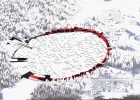
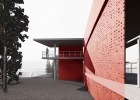
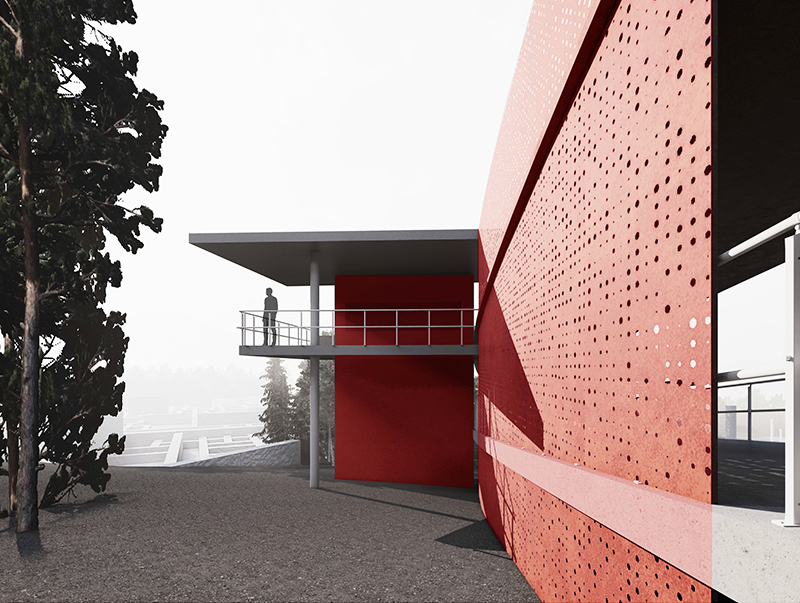
About her her project, Arch. Nowruz indicated that it came under the name (The Lost Part) to focus on the Zionist occupation’s attempt to erase any trace of the Palestinian people in the village of Saffuriyya, as they planted the hill that included the village with unfruitful forest trees to remove any trace of Saffuriyya.
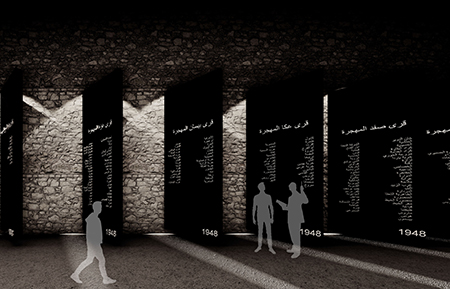
She added that the dilemma was the occupation's use of trees as a tool to erase the memory of the place, the idea of transferring the trees to the vicinity of the project, which was formed from a circular ring working as a memorial garden displaying all the antiquities that passed through the village. The underground museum represents the missing part of the novel; the Palestinian part up to the memorial in the middle of the ring where the original village was. Columns were planted in the place of each house in the village, on which the name of the Palestinian family that lived there before 1948 was written. As for the project of Arch. Ala'a, which came under the name “I am the sea” in the abandoned village of Al-Joura, it focused on reviving the event of Ayoub’s Wednesday, which was held every year in Palestine before the Nakba to celebrate the sea.
Amro re-traced the itinerary by creating three stations. The first station is in the place of the original village and contains the main square around which the main restaurants and markets, including the fish market. The second station was a symbolic station holding an orange orchard and a festive amphitheater symbolizing the celebrations that occurred on Ayoub's Wednesday. The last station was directly on the sea with a large amphitheater and a garden fronting the sea. Under the amphitheater, a maritime museum and workshops that were used to construct traditional fishing vessels were designed.
In turn, Arch. Qub’a thanked the students for their tremendous efforts during their work on the graduation projects, which led to this distinction and success, stressing the importance of the competition as it focuses on preserving the memory of the people.
He also emphasized the remarkable outcomes of SABE students' graduation projects, proven in many winnings at local and international contests. Qub’a also appreciated the efforts of colleagues at SABE for their continuous efforts and support.