

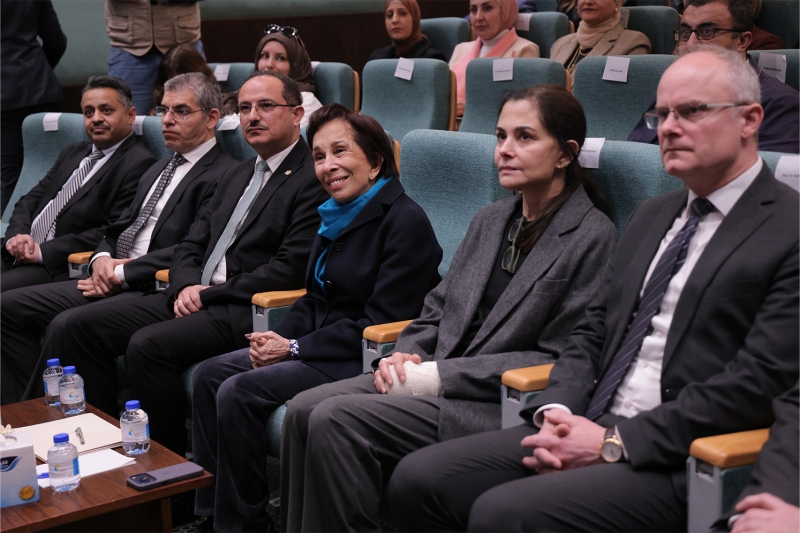
 Her Royal Highness Princess Basma bint Talal patronized the ceremony marking the launch of the PhD Program in Social Work at the German Jordanian University (GJU) on Monday, in the presence of University President Prof. Ala’a Al-Deen Al-Halhouli and Vice President of Hamburg University of Applied Sciences, Prof. Peter Wolf.
Her Royal Highness Princess Basma stated that the importance of launching the PhD program in social work lies in the urgent need for better approaches to understanding and practicing development. She emphasized that social service institutions in our region and around the world operate under enormous pressure, responding to conflict, displacement, poverty, inequality, climate stress, and rapid demographic changes, often with limited resources and fragmented systems.
She added that “the realities faced by communities are often presented through short-term projects, rigid institutional frameworks, or external models that struggle to reflect lived realities.”
She explained that “this program presents the PhD as a tool to reimagine development in practice, grounded in real institutions, communities, and constraints. It creates space for rigorous research that is not detached from practice, but rather interacts with it—analyzing how social service systems function, how power and decision-making operate within institutions, and how organizations can adapt to better serve the people for whom they exist.”
Her Royal Highness Princess Basma noted that “through my work at the Jordanian Hashemite Fund for Human Development (JOHUD), I see daily that sustainable transformation is not achieved by importing models or increasing projects, but through listening, learning, and institutional self-reflection. Communities are not passive recipients of services; they are holders of knowledge, experience, and solutions. Social work must help reclaim this voice and translate it into policies, organizational change, and more responsive systems.”
She pointed out that “the PhD program we are launching today creates the necessary conditions for precisely this type of work. It strengthens the social service sector from within, supports institutional learning, and connects policy with lived reality, linking research directly to how services are designed, delivered, and managed.”
She continued, “This is not research for its own sake; it is research that serves individuals, institutions, and communities under pressure. It aims to equip practitioners, leaders, and communities with the knowledge needed to transform development practices. In this sense, the program is not merely academic; it is highly practical, deeply relevant, and essential.”
Her Royal Highness congratulated the GJU, and its partners on this important step, expressing her anticipation for the contributions of this specialized academic field to social work, development practices, and institutional transformation in the coming years.
In turn, the President of the German Jordanian University, Prof. Ala’aaldeen Al-Halhouli, stated that the launch of the PhD program in social work at GJU in partnership with Hamburg University of Applied Sciences, is fully aligned with Jordan’s Economic Modernization Vision, which places human capital development, social protection, and evidence-based policymaking at the core of sustainable economic growth.
He added that the program responds to the growing national, regional, and international demand for highly qualified specialists in social work, making it the first PhD program in Social Work in Jordan and a milestone reflecting the confidence of both the academic and national communities in the university’s standing and its scientific and humanitarian role.
The Dean of the School of Applied Humanities and Social Sciences (SAHSS), Prof. Haytham Althawabih, explained that the program embodies an advanced model of academic cooperation between the German Jordanian University and Hamburg University of Applied Sciences, contributing to the preparation of qualified researchers who support national development goals and address contemporary social challenges.
For his part, the Vice President of Hamburg University of Applied Sciences, Prof. Peter Wolf, expressed his pride in this academic partnership, affirming that it represents a model for international cooperation in higher education and for building high-quality programs with sustainable societal impact.
The program aims to prepare specialized researchers in social work through a structured training approach that combines applied scientific research with advanced professional qualification. It focuses on contemporary social issues and cross-border challenges, and supports the development of evidence-based policies and interventions.
The ceremony included a presentation given by academics from both universities, highlighting the philosophy of the program, its research themes, and its objectives in advancing knowledge and linking it to decision-making and social policy.
The event concluded with a scientific panel discussion on the role of joint research programs in addressing social challenges and the importance of international academic cooperation in creating the real impact on communities.