

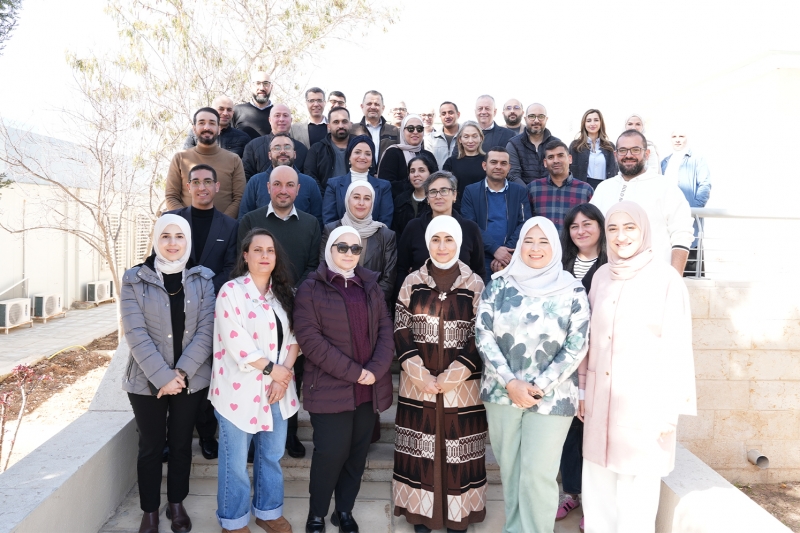
 The German Jordanian University (GJU), represented by the Center for e-Learning and Academic Performance Improvement (CeLAPI), concluded its fourth training program titled “Active Learning Design,” held from 10 to 12 February 2026, totaling 16 training hours, with the participation of 40 faculty members from various schools across the University.
The program aligns with CeLAPI’s vision of empowering education through digital transformation and innovation, and reflects its mission to provide advanced digital learning solutions and faculty development that enhance academic performance and promote sustainable educational practices.
The training was delivered by Eng. Salma Abu Ayyash, Director of the Center for Teaching and Learning at Al Hussein Technical University (HTU). The sessions focused on integrating principles of cognitive science into classroom practice and designing engaging learning environments that foster deep understanding. The program also introduced the GAPA framework (Goals – Activities – Products – Assessment), a backward design model that ensures alignment between learning goals, classroom activities, expected outputs, and assessment tools within an integrated educational system.
Participants engaged in intensive hands-on workshops, redesigning selected course units and shifting from traditional lecture-based approaches to active learning strategies, including project-based learning and peer instruction, thereby reinforcing students’ roles as active partners in the learning process.
Dr. Ziad Abu El-Rub, Director of CeLAPI, emphasized that the program aimed to strengthen faculty members’ awareness of their central role in shaping meaningful learning experiences. He highlighted that effective active learning design depends not only on tools and models but also on the instructor’s ability to integrate personal and academic expertise within a structured scientific framework. He noted that the training enabled participants to transform their accumulated experience into deeper and more impactful teaching practices.
The program also addressed the responsible use of artificial intelligence (AI) in supporting instructional design, in line with the University’s broader digital transformation and innovation agenda.
The program concluded with a commitment to implementation and follow-up, as participating faculty members will apply the GAPA model in their courses during the upcoming semester, supported by CeLAPI, as part of GJU’s continuous professional development culture.